
It’s that dreaded time of year again. No, not Self-Assessment deadline time for filing the yearly tax return… rather, it’s time for the UK’s fungus population to put forth their fruiting bodies and induce paranoia in pet-parents across the whole of the country!
If you’ve successfully navigated your way through your dog’s puppyhood, survived adolescence, arrived at adulthood, and are confident that you’ve encountered (and overcome) all of the potential dangers your canine companion might encounter, it’s a good time to remember that there is always that hidden menace lurking beneath the ground, ready to poke up its mushroomy head and offer a potentially tempting, and occasionally deadly, treat to your dog.
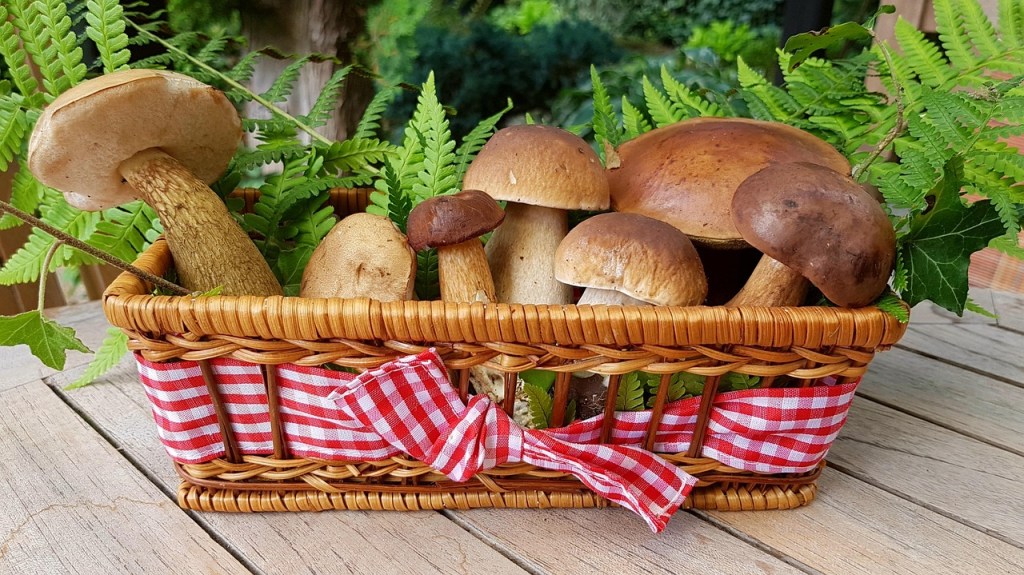
Here in the UK we have over 15,000 species of fungus present in our environment, from the weird-looking Bracket Fungi (those odd things you see growing on usually decomposing tree trunks), to the humble and delicious edible Bay Bolete, to the ethereal and thankfully brightly-coloured Fly Agaric, we’re fortunate to have a wide variety of fungi that share our space. Fungi are a vital part of the ecosystem, helping to decompose organic matter and forming vital mycorrhizal relationships with trees and plants.
While it’s almost always perfectly fine for our dogs to consume our regular store-bought mushrooms (they don’t provide any nutritional benefit, but likewise shouldn’t cause any harm), the same cannot be said for the majority of the mushrooms and toadstools you’ll find growing wild.
But this is where it gets a little confusing. Wild Foods UK lists 132 species of edible mushrooms. Out of 15,000 species of fungi. Tails.com claims that 99% of the 15,000 are edible. The Woodland Trust, on the other hand, states that there are ‘over a hundred’ species of edible mushrooms to be found on our island. Somewhere between the sublime and the ridiculous must lie the truth… but it seems the internet isn’t a particularly reliable source of information in this case. I’ve added in the links in case you’d like to do your own reading on the subject.

Some mushrooms are very obvious in communicating to us that they’re not to be messed with. We imagine fairies sitting on them, hanging out and doing lazy fairy things, but I doubt there’s a child in the UK who hasn’t been told by their parents or school teachers that the brightly-coloured Amanita Muscaria (also known as Fly Agaric) is highly poisonous and should not be eaten or even touched. Its striking colour makes it immediately obvious against the green and brown undergrowth, and ensures we hold it in healthy respect.
But not all fungi are as overt in their warnings. Type ‘fungus poisoning’ into Google and you’ll be assaulted with an assortment of horror stories. Dogs eating mushrooms. Humans using fungi as a murder weapon. Innocent foragers accidentally consuming a mere half of a ‘destroying angel’ cap (any number of Amanita varieties) and succumbing to systemic organ failure.
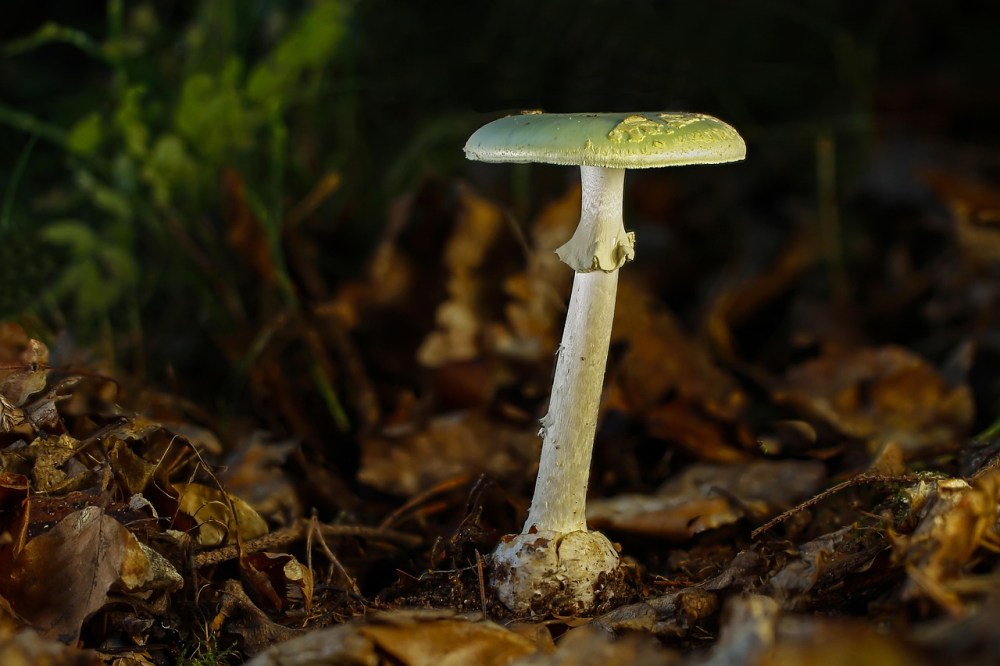
What does mushroom/fungus poisoning look like in dogs? Well, it depends on a number of factors, such as what type of mushroom was ingested, how much of it was ingested, how large/small your dog is, and how quickly you were able to seek veterinary help after it was eaten.
Mushrooms, as with many things, can be categorised according to their toxicity. I won’t go into which mushrooms/fungi fall into which category, because (as with many mushroom identification sites), the potential for getting it wrong is too great. Let’s just say that if your dog eats a mushroom, and it didn’t come from a plastic carton that you bought from your local Tesco or Aldi, then you should seek immediate medical advice.
Those mushrooms which are not categorised as highly toxic might result in gastrointestinal distress for your dog (or you, your child…. anybody unfortunate enough to have put the mushroom in the mouth. Just don’t do it.) Vomiting, diarrhoea… if you don’t know that your beloved pet has eaten one of these mushrooms, you might even mistake the symptoms for a simple GI bug. And, with any luck, these symptoms should pass.
Then you have the mushrooms which are more dangerous. They might affect old, young, or infirm dogs more strongly. Some contain neurotoxins, and others can have a neurotoxic effect. In short, we’re talking about anything that affects the nervous system. Loss of motor control, drooling, and even seizures. And again, if you don’t know your dog has ingested something, you and your vet might be at a loss, and looking for things such as epilepsy may delay a treatment for mushroom poisoning.
Finally, you have those mushrooms that are lethal. Amatoxins usually start by affecting the liver, but can also affect the kidneys, GI tract, respiratory system and the heart. And it takes a frighteningly small amount to be consumed for the effects to be fatal.
Are you worried yet? Or at least, mildly concerned? I hope so. Being a pet-parent is difficult enough in this day and age. Between the Parvo scares, the constant battle against fleas, the unexpected ticks that your dog accrues on that holiday to Scotland, the cut pads, dental issues, allergies, daily “dog loose on High Street” FB community posts, not to mention the need to be conscious of too much heat, too much cold, dietary requirements and training, it’s hard enough being Mum or Dad to a dog without having to worry about Fido ingesting the UK’s most toxic mushroom on your dairy soirée in the local woods.
But don’t panic. There are some things you can do to help minimise the risk of your beloved pet deciding to be canine equivalent of Bear Grylls.
“But what can I do?” I hear you cry.
Well, it’s all about management, management, management. And how much you need to manage will depend on you, your dog and your environment. But let’s start with some basics:
- Be present. You’re walking your dog. Put your mobile phone back in your pocket. Tiktok can wait. Trust me, it’s not going anywhere. And when Karen from down the road stops you for a chat, keep at least one eye on your dog at all times.
- Be observant. Fungi aren’t like off-lead dogs, suicidal squirrels or that deer that always decides to run across your path at the most inconvenient time. They aren’t going to sneak up on you. There’s no such thing as a Ninja Fungus. Or if there is, I want one! Keep your eyes peeled for them. Look at tree trunks and tree stumps. Monitor fallen trees. Watch the undergrowth carefully. We are visual creatures. There’s a good chance you will SEE a mushroom before your dog does. Your dog experiences the world through its nose, so you have an advantage here.
- Use your lead. If you’re in an area where you know there are a lot of fungi, and you think there’s a chance your dog might try for a nibble, then keep your dog on the lead. If Fido’s fifty metres off the path, in forest so dense that you can only hear him and not see him, then you don’t know what he’s doing. Maybe he’s just sniffing around. But if you can’t see him, you don’t know what he’s eating.
- If your dog DOES eat something funky-fungus looking, get a sample of it. BUT WAIT! Don’t just dive in there and start picking up mushrooms and shoving them in your pocket like they’re piñata candies you nicked from your nephew’s birthday party. You don’t know what they are. Some fungi are poisonous even if you simply TOUCH them. So, use a poop bag. You know, those things you always carry on you because you’re a responsible dog owner? Treat those fungi like they’re the stinkiest of poops. Bag it and tag it. Then get your dog to your vet. Maybe your dog ate what M&S sells on their shelves. But maybe it didn’t. Don’t take the risk.
- Teach a “leave it” command. I teach this in puppy class. I give my students scenarios… you’ve dropped a battery, you’ve dropped a packet of Ibuprofen, you’ve dropped the Christmas Turkey, and you need your dog to pause before dashing in and gobbling these forbidden fruits from above. But this applies to anything and everything you might find in your environment as well. Chewing gum. Cigarette ends. Face masks. Humans are disgusting and will drop anything and everything without care for the consequences. But having a ‘leave it’ for fungi might just save your dog’s life.
- Muzzle-train your pup. Not every dog will ‘leave it’. Some dogs don’t care for leaving things. Some will resource-guard. If you have your dog off-lead, and it’s out of sight, then you can’t tell it to ‘leave it’ because you have no idea what it’s doing away from your supervision. Muzzles are often used to prevent a dog from consuming something they shouldn’t while out in the big wide world. So forget the stigma that muzzles are only for “aggressive dogs.” They’re not. Muzzles are the hallmark of a responsible owner. A good basket muzzle will minimise your dog’s chances of ingesting something bad.
- Be aware of your dog’s age. If you’ve ever owned a puppy, you’ll probably have spent time removing things from their mouths. Socks. Sticks. Face masks. KFC wrappers. Empty cans of Red Bull. Leaves. Stones. Carrier bags. Poop bags. Half-eaten sandwiches. Dog poop. Cat poop. Fox poop. Your beloved hydrangeas. And, once upon a time in my case, two pairs of spectacles and a computer processor. Puppies explore the world through their mouths. They’re much more likely to try randomly eating things than adult dogs are. So be aware that puppies are high-risk when it comes to random fungi.
In An Emergency
If there is only one piece of information you take away from this article, then take this.
If your dog has consumed something that is potentially poisonous, and you cannot take it immediately to a vet, then you can call the the Animal Poison Line UK.
The call will cost you £35 – £45. You will speak to a veterinary poison specialist. They will ask you questions and tell you whether or not you should rush your dog to a vet. They deal with poisons of all sorts, including chemical, agricultural, medicinal, and also bites and stings.
This is their website: https://www.animalpoisonline.co.uk/
This is their phone number: 01202 509000
Save these details in your phone, because you never know when you may encounter a poisoning situation. They are the next best thing to your actual vet.

Be aware as well that fungal fruiting, contrary to popular belief, isn’t season-specific. It’s not something that only happens in the autumn, though it may be more common during this season due to the more favourable environmental conditions (namely, increased moisture and an influx in organic matter as deciduous trees drop their leaves). Fungi can appear at any time. I was seeing them this year (2025) in early June and throughout July, in my garden and the gardens of others. In the woods/forests where I walk, I see them year-round on decomposing trees. They don’t just appear in autumn. They’re always there, waiting for… as Captain Jack Sparrow would say… the opportune moment.
And now, time for some good news. Fungi, and their fruiting mushrooms, are a vital part of our ecosystem. They’re like icebergs. 90% of them are under water (or in our case, under the ground). You only see the top 10% of them. And without them, our ecosystem could not sustain itself. So even though you have to be wary of them on your dog’s behalf, be glad that they’re there. They’re a fantastic indication that nature isn’t fully broken yet. And that no matter how many face masks we casually toss away, life will find a way to go on.
Just don’t eat the mushrooms. Seriously. Get them from Lidl. It’s much safer.
 Dog Ways Lancashire